
Women’s Center Release Paths
The Western Massachusetts Regional Women’s Correctional Center is an HCSO-operated, multi-level regional county correctional facility for women. It holds pretrial and sentenced populations. “Regional” is essential. The facility sits in Chicopee, but a committing court, sheriff, or other agency outside Hampden County may own the legal matter that led to custody.
A pretrial release may follow bail, a court order, or a video-facilitated court action. A sentenced resident may reach sentence expiration, parole, probation, or another authorized endpoint. Some women move to the Western Massachusetts Recovery and Wellness Center or another structured placement. Others transfer to another sheriff, MA DOC, federal custody, or a different authority. Only the first set of outcomes may represent community release, and even then supervision or court terms can continue.
| Exit route | Meaning | Record to pair with HCSO |
|---|---|---|
| Bail or court release | The controlling pretrial matter permits exit, subject to other holds | Originating court docket and mittimus |
| Sentence or supervision release | A sentenced phase ends or changes to parole or probation | Sentence, release event, and supervision source |
| Program movement | The placement changes, but custody or structure may continue | HCSO movement record and final event |
| Agency transfer | WCC custody ends and another authority receives the person | Receiving-agency confirmation |
Regional Release Court Search
The women’s center cannot be searched as if every case began in Hampden County. HCSO’s 2023 community-release cohort for pretrial women shows why: 35.4 percent of 817 events involved Hampden cases, while 45.9 percent involved Worcester cases. Other counties also appeared. Those figures describe a past cohort, not a live person list, but they prove that facility location does not identify the controlling court.
Start with the exact docket number and originating division. Massachusetts online access generally requires the exact docket number for most public criminal cases. Search the MassCourts public system, open the chronological docket, and read the disposition and sentence or order. If the matter is not publicly visible, contact the clerk that owns it. A sealed, impounded, juvenile, or confidential matter can be restricted.
The docket establishes judicial action. It does not give the exact time the woman passed through the WCC exit. Staff must still review holds and complete processing. HCSO’s release event is the physical-custody record. When an event names a transfer, follow the receiving agency rather than treating the court action as a completed community release.
Note: A name-only online court search can fail even when a public criminal docket exists because exact docket numbers often control access.
Confirm Women’s Center Release
HCSO publishes no public roster, 24-hour list, 72-hour list, or named release archive for WCC. Massachusetts VINELink is not the substitute. The Commonwealth states that only MA DOC participates in Massachusetts VINE, while the Western Massachusetts Regional Women’s Correctional Center is sheriff custody. A missing VINELink result says nothing definitive about a WCC release.
- Collect the full name, lawful date-of-birth information, aliases, booking number, approximate dates, originating court, and exact docket when known.
- Review the public court docket for bail, sentence, disposition, probation, warrant, or later order language.
- Request the WCC booking and final release or transfer event from the HCSO Records Access Officer.
- Compare the HCSO event date, type, destination, and legal reference with the docket rather than relying on one source alone.
- If another agency received the woman, verify that agency’s custody or discharge record as a separate event.
A narrow request should ask for actual release date and time, releasing facility, booking number, release type or destination code, and the related mittimus or docket reference. If only simple confirmation is needed, limit the request to those event fields. This can reduce redaction and avoid asking HCSO to create a summary that its system does not already hold.
The Hampden County release-record search provides the full fallback chain when a person moved among sheriff, state, federal, or immigration systems.
Women’s Center Bail Times
WCC publishes facility-specific bail-release processing times. The official WCC bail page lists 4 p.m. Monday through Friday, and 9 a.m. plus 4:30 p.m. on Saturday and Sunday. These times apply to the center’s stated bail workflow. They are not a universal release schedule for sentence expiration, court release, transfer, parole, probation, or another legal event. The official page does not state a holiday rule.
Bail on one mittimus also may not produce a physical exit. A second court matter, warrant, or other hold can continue custody. The right question is not merely whether bail was posted. Ask whether release processing was completed, whether another hold remained, and what destination appears in the final WCC event.
The captured WCC bail information shows the facility’s published schedule.
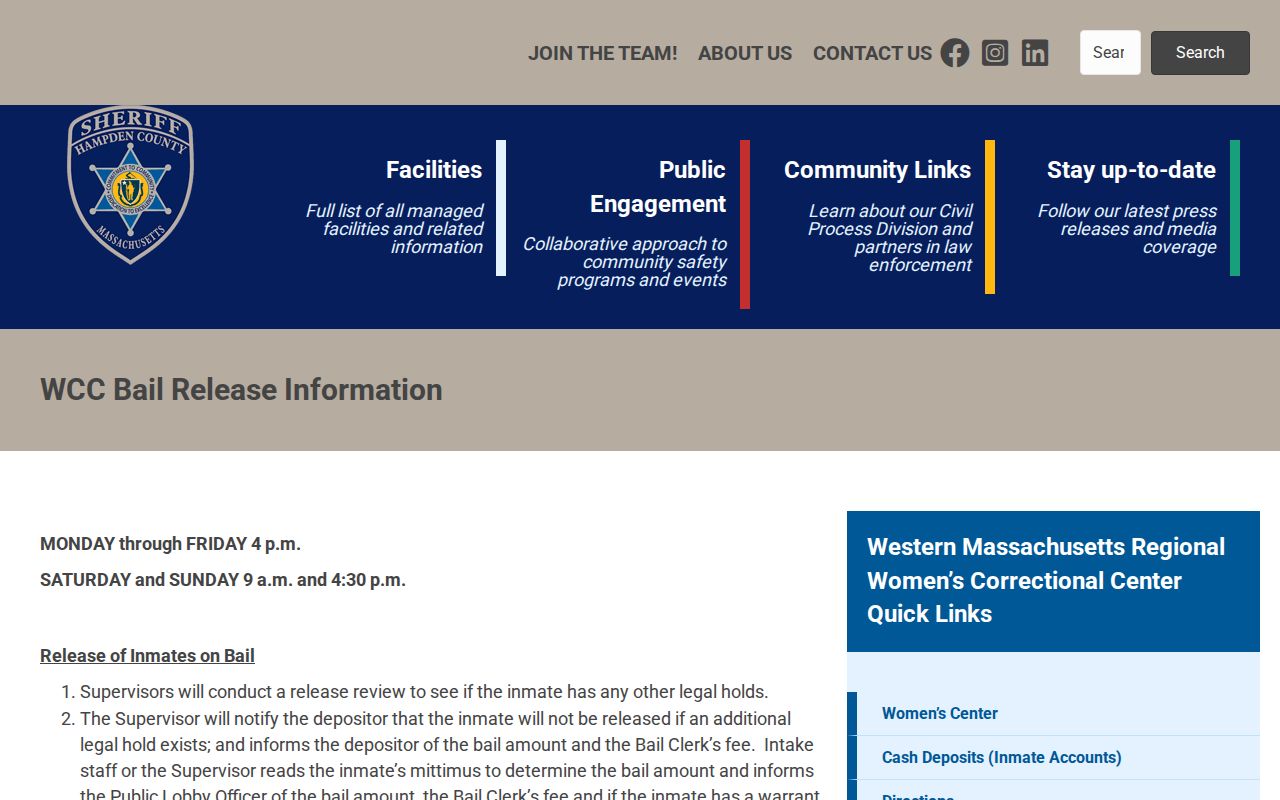
The schedule is useful for planning a bail inquiry, while the event record remains the proof of what actually happened.
Women’s Center Release Records
HCSO’s centralized Records Access Officer handles the formal record path. Written requests may be sent by email or mail. The official page expressly says the office does not accept telephone or voicemail public-record requests. Its phone number is limited to process questions and the status of a request already submitted. Identify the Western Massachusetts Regional Women’s Correctional Center in the request and include the originating county or agency when known.
HCSO Records Access Officer
Theresa S. Finnegan, Assistant Superintendent and General Counsel
Hampden County Sheriff’s Office
627 Randall Road
Ludlow, MA 01056
Email: theresa.finnegan@SDH.state.ma.us
Fax: (413) 589-1851
Questions or status: (413) 858-0164, Monday through Friday, 8 a.m. to 3 p.m.
The HCSO records page is the source for those channels. Ask for electronic production and permit lawful redaction. CORI, privacy, medical, investigatory, security, juvenile, sealed, or other protected content can restrict details. A restricted field does not mean no release event exists.
WCC intake rules also maintain booking material, including an identifying photograph. HCSO provides no public booking-photo gallery. If a photograph is necessary for a purpose-neutral identity check, request the specified booking image as a separate existing item instead of assuming it comes with the release sheet.
Note: HCSO posts no WCC-specific release-record fee, so request an itemized estimate before work that may create a charge.
Women’s Center Contact Details
The facility’s operational contact is distinct from the RAO record channel. The HCSO led by Sheriff Nick Cocchi lists the Chicopee address, main number, and intake fax. Staff may explain an operational procedure, but a formal request for the existing release event belongs with the RAO. Confirm current visit or property procedures before travel because WCC publishes separate property and account rules that should not be generalized to every final discharge.
Regional Women’s Correctional Center
Western Massachusetts Regional Women’s Correctional Center
701 Center Street
Chicopee, MA 01013
Main phone: (413) 730-6800
Intake fax: (413) 730-6991
The official WCC facility page is captured below.
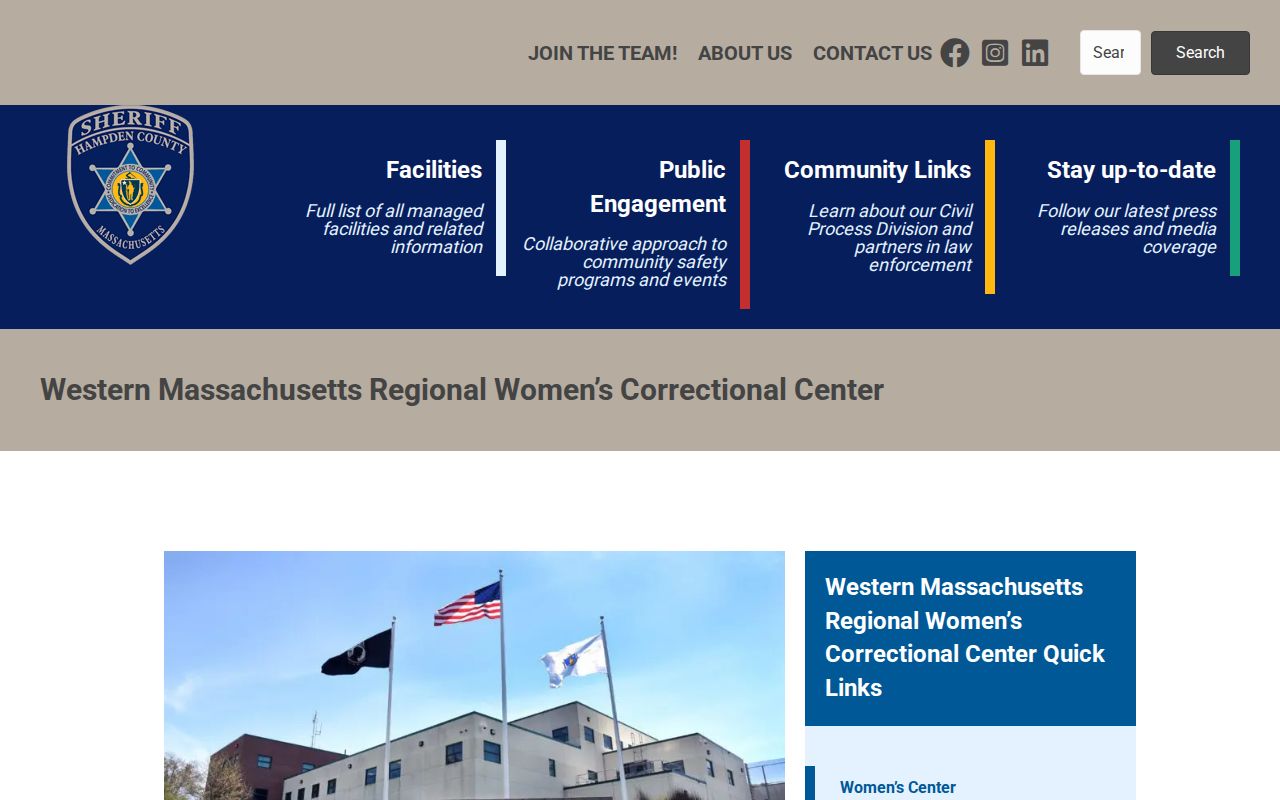
The official page confirms the regional facility identity and contact source, while the final HCSO event explains the person-specific exit.
Women’s Release Record Meaning
Read the result as a chain of events. A “release at court” code may indicate that the court handled the legal release, but it does not by itself provide the door-exit time from every setting. A move to WMRWC is not the same as full discharge. A transfer to MA DOC, another sheriff, a federal authority, or another jurisdiction is an exit from WCC custody and a possible start of new custody.
- Community release
- The person physically leaves custodial placement, though supervision or court terms may remain.
- Movement
- The person changes HCSO location or program while legal custody or structure may continue.
- Transfer
- Another agency receives or may receive custody after the WCC event.
- Parole
- Conditional release from a custodial sentence under the Massachusetts Parole Board.
- Probation
- Court-administered supervision that may follow custody or begin without it.
Exact wording matters because HCSO’s local “Release to Community” category deliberately excludes transfers. When two sources disagree, classify each date first: bail posting, court disposition, release authorization, facility movement, or executed exit. Then ask the office that owns the disputed field for correction or context.
After Women’s Center Release
A woman returning to the community may be on parole, probation, or another court condition. The sentence and final event identify which system to check. Parole Board material can show a decision, yet a grant is not proof that release was executed that day. A public docket may show probation, but protected supervision details are not open to all callers. Use each office for the status it owns.
WCC’s regional role also affects follow-up. If a Worcester court supplied the mittimus, its clerk and probation office may hold the durable case trail. If another sheriff receives the woman, that sheriff’s record begins where HCSO’s event ends. When Massachusetts Department of Correction is the destination, the Commonwealth’s VINELink route can help with state status. Do not use it for the period when WCC alone held the person.
For movement to the regional recovery and wellness placement, the Mill Street custody and release explanation distinguishes structured placement from final community discharge. That distinction prevents a program move from being misread as a completed release.