
Hampden Projected Versus Actual Release
A projected release date is an estimate based on the sentence record and credits or legal events known at a given point. Actual release is the executed custody-exit event after the final review of the mittimus, sentence calculation, warrants, holds, and destination. The dates can match, but they answer different questions. Keep the source's label rather than calling every future date “release.”
A pretrial person at the Hampden County Correctional Center may have a bail amount or a court date without having a fixed release date. Bail on one mittimus does not defeat another hold. HCSO's published procedure says an Intake Supervisor reviews legal holds before release, and an ELMO condition can result in transport to court instead of a direct community exit. ELMO refers to electronic monitoring arranged through the court and Probation.
Sentenced terms can support a calculation, but even a computed date is not the physical release record. A person may transfer to MA DOC, another sheriff, federal authority, or immigration rather than return to the community. The receiving agency must answer what happened next.
Find Hampden Projected Release Dates
The search route turns on custody. Massachusetts does not offer one public calculator or database that combines HCSO and MA DOC sentences. The official public MA DOC locator route goes to VINELink, but the Commonwealth does not promise that every public record shows a durable projected-date field. HCSO publishes no named-person roster or projected-release search.
- Identify the last known facility, custody agency, exact name, booking or commitment number, and court docket.
- Read the controlling court judgment for sentence length, minimum and maximum terms, concurrency, consecutive terms, and prior-confinement credit.
- For HCSO custody, ask the Records Access Officer for the existing calculation or release-event fields when legally available.
- For MA DOC custody, check the state VINELink route and copy any date exactly as labeled. Do not assume a missing field means no calculation exists.
- Use the MA DOC records process for a sentence computation, movement, or release record when the public result is incomplete.
- Check parole decisions, other cases, warrants, and detainers before treating the working date as a community-release date.
- After the event, obtain the actual release or transfer record and compare it with the projection.
The Hampden County release-record path provides the HCSO request details and court sequence. A narrow request should name the person, facility, approximate dates, booking or commitment number, and the exact existing fields sought.
Massachusetts Release Date Labels
Massachusetts uses several date terms. They should not be merged. The MA DOC glossary defines the base vocabulary, while the sentence and computation record shows which terms apply to one person.
- Release Date
- The date calculated from sentence terms without deductions, serving as a base for later calculation.
- Earliest Release Date
- The earliest eligibility date considering parole eligibility and applicable deductions.
- ERD Max
- A date based on the controlling maximum and applicable earned or completion deductions, excluding parole eligibility.
- Release to Supervision Date
- A statutory date based on the maximum term less eligible credits and subject to limits and conditions.
- Actual release
- The event carried out after final review, whether to community, supervision, or another custodian.
The official MA DOC glossary capture below provides the Massachusetts terms used to distinguish these dates.
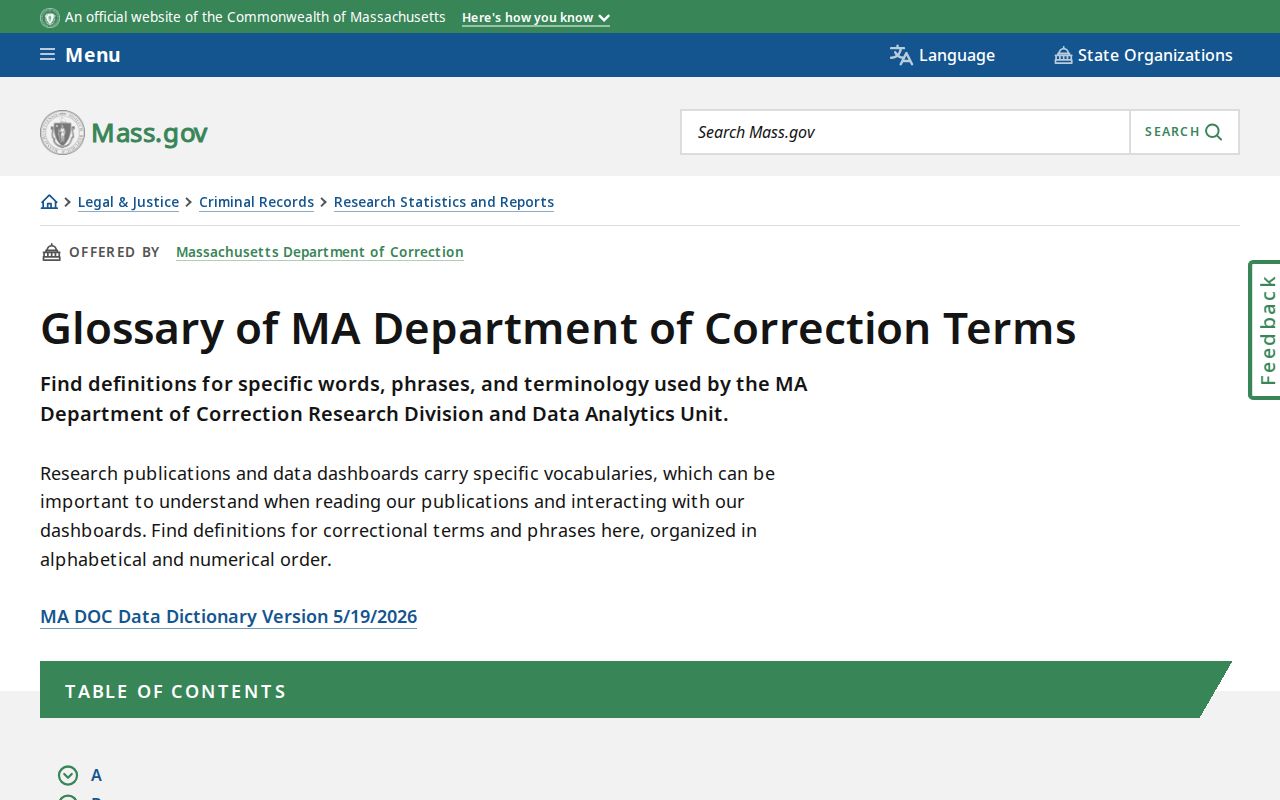
Use the label on the live record or document, then state whether it is an estimate, eligibility point, supervision date, or completed event.
Hampden Earned Release Credits
M.G.L. c. 127, § 129D authorizes earned deductions for qualifying programs and activities. State-prison sentences may receive up to 7.5 days for each qualifying program or activity per month, with a 15-day monthly maximum. House-of-correction sentences may receive up to five days per program or activity per month, capped at ten days per month.
The statute also provides specified completion deductions. Some state-prison designated completion credits can reach 80 days, while aggregate completion credits may not exceed 17.5 percent of the imposed maximum. The applicable combination of deductions is subject to a 35 percent limit in the statute. Separately, Section 129C permits up to 2.5 days per month for satisfactory conduct in a prison camp.
These are maximum legal possibilities, not a formula that can be applied to every month. Eligibility depends on the offense, sentence, program, performance, completion, and agency record. Credits can be forfeited or restored. The official calculation, not simple subtraction, controls the working date.
Note: A house-of-correction credit rate and a state-prison credit rate are not interchangeable in a Hampden release calculation.
Hampden Release to Supervision
M.G.L. c. 127, § 130B defines the Release to Supervision Date, often called RTS. It uses the maximum term less eligible deductions and completion credits, with the statute's 35 percent reduction cap. When its conditions are met, a state prisoner not already paroled may receive a permit for the balance of the sentence.
RTS is not full discharge. It is release to parole supervision for the rest of the sentence. Mandatory minimums must first be served, and the law excludes specified habitual-offender and other-sovereign circumstances. An approved plan and other conditions also matter. A displayed RTS date therefore answers a narrower question than the end of all legal supervision.
The public locator does not promise to display RTS, ERD, ERD Max, or a projected discharge for every Massachusetts record. If a record shows one, preserve the exact term. If it does not, request the computation from MA DOC rather than guessing from the sentence.
No Massachusetts 85 Percent Rule
Massachusetts has no universal rule that every prisoner must serve 85 percent of a sentence. The federal shorthand should not be imported into a Hampden County calculation. Massachusetts truth-in-sentencing changes removed older statutory good-time deductions for offenses committed after the relevant cutoff, but current law still provides earned program, activity, camp, and completion credits under its own rules.
M.G.L. c. 279, § 24 requires minimum and maximum terms for ordinary state-prison sentences. It does not establish an across-the-board 85 percent formula. Parole eligibility, RTS, mandatory minimums, earned credits, sentence structure, and exclusions must be read from the controlling legal and correctional record.
This distinction is especially important when a date is described only as “earliest,” “maximum,” or “projected.” Each can reflect a different part of the calculation. Ask which deductions have already been earned, which are only projected, and whether the date assumes parole or supervision.
Why Hampden Release Dates Change
A sentence computation is a working legal record. The court terms set its base, but later facts can change the controlling end, the earliest release point, or the destination. Ask the agency to identify the reason for a change rather than assuming an error.
| Factor | Possible effect |
|---|---|
| Earned or completion credits | Move an eligible projected or supervision date earlier as credits are actually earned |
| Forfeiture or restoration | Removes or returns credit based on the official institutional record |
| Corrected jail credit | Changes credit for lawful prior confinement |
| Concurrent or consecutive terms | Changes which sentence controls and when the aggregate term ends |
| Court revision | Alters the judgment, sentence, or credited time |
| Warrant or detainer | Can prevent community release or cause transfer to another authority |
| Parole action | May authorize conditional release, deny it, postpone it, or rescind a prior grant |
A detainer is a request or legal basis for another authority to take custody. If HCSO or MA DOC records a transfer, report both events: departure from the first agency and entry or possible entry into the next. That event is not the same as release to the community.
Confirm Hampden Actual Release
For MA DOC custody, the Hampden VINELink inmate search can support a status check and notification registration. It is secondary to the DOC's movement and release record, and data can lag. VINELink does not cover HCSO facilities. Do not wait for an alert that the participating agency will never send.
For HCSO, request the actual date and time, releasing facility, release type or destination code, booking number, and legal case or mittimus reference. The HCSO Records Access Officer accepts written requests by email or mail, not phone or voicemail. MassCourts can corroborate the legal event, though the docket does not time-stamp the facility door exit.
Immediately before release, the correctional agency reviews the controlling papers, calculation, institutional record, warrants, holds, and destination. Afterward, compare the executed record with the projected date and preserve both. If they differ, classify each date first and ask the source agency to explain or correct the field.
Note: “Not found,” an expired estimate, and a changed facility are not affirmative proof that a Hampden County release occurred.
Hampden Sentence Calculation Order
The mittimus and court judgment begin the calculation. They establish the sentence length, minimum and maximum terms when applicable, whether terms run at the same time or one after another, and credit for prior confinement. Concurrent terms run together to the extent ordered. Consecutive or “from and after” terms can push the controlling end later. The correctional agency must calculate the full set, not one charge in isolation.
MA DOC then determines the controlling or aggregate term and applies only credits allowed for that sentence and actually shown in the record. A program credit that might be earned in the future belongs in a projection, not in a statement of credit already earned. The same care applies to parole. Eligibility opens a possible route to conditional release, but a Board grant must still be put into effect and may lead to another custody rather than the community.
Hampden house-of-correction terms need their own record. Such a term is generally limited to two and one-half years, and the Section 129D rates for house-of-correction programs differ from state-prison rates. Pretrial jail credit, time served ordered by the court, HCSO calculations, and other holds can all affect the event. HCSO's documented court-data migration issue is one reason to compare the sheriff record with the exact court docket.
103 CMR 410 supplies the Massachusetts sentence-computation and release-review framework. It includes the calculation, approval, and release-certificate process. A record request can identify the computation or certificate by name and commitment number rather than asking staff to create a new forecast.