
Stonybrook Civil Commitment Status
The Stonybrook Stabilization and Treatment Center is a secure, regional civil-treatment facility approved by DPH and operated by the Hampden County Sheriff’s Office. It principally serves men civilly committed for substance-use treatment under Massachusetts General Laws chapter 123, section 35. That legal basis is not an ordinary criminal conviction or house-of-correction sentence, even though HCSO operates the secure Ludlow site.
Section 35 begins through a court petition and commitment process. The placement can continue within the statutory framework and is subject to scheduled review and discharge criteria. The final event should therefore be described as discharge from, completion or termination of, or transfer under the civil commitment. Calling every endpoint an “inmate release” erases the nature of the placement and can misstate the record.
A person can have another legal issue at the same time. A warrant, criminal mittimus, or other custodial order may lead from Stonybrook to a jail or another agency. In that case, report the civil-treatment exit and the new custody as separate events.
Stonybrook Discharge Outcomes
Stonybrook’s possible destinations are unusually important. A man may return to the community after the civil commitment ends. He may go back to court, transfer to another Section 35 treatment center, receive a medical movement or rescission outcome, or enter a jail or other criminal-justice agency because a distinct order applies. The center’s final event and the committing court record should identify which path occurred.
HCSO’s 2023 Release Report provides local outcome categories. It lists 537 regular or community releases. Separate exits include 113 to jail or another criminal-justice agency, 42 to court, three medical rescission or Section 12 outcomes, and two transfers to another Section 35 center. These are annual historical measures, not a current-person lookup. More important, the report keeps the categories separate. All of them must not be called released inmates.
| Stonybrook endpoint | Accurate reading | Follow-up source |
|---|---|---|
| Community discharge | The civil placement ended with a community destination | HCSO event and committing court |
| Court | The person left for judicial action, not necessarily for the community | Committing court and later event |
| Another Section 35 center | Treatment custody or structure continued elsewhere | Receiving facility or court process |
| Jail or justice agency | A separate criminal-justice custody may have begun | Receiving custodian and criminal docket |
Confirm Stonybrook Civil Discharge
Stonybrook has no public named-person discharge feed. Massachusetts VINELink is not the correct system for this civil HCSO placement because only MA DOC participates in the state VINE program. A missing result has no meaning for Stonybrook. The proper inquiry is narrow and status-focused: ask HCSO or the center for the releasable fact and date of discharge or transfer, and check the committing court for the civil order.
- Identify the exact name, lawful identifying details, approximate commitment period, committing court, and case reference when available.
- Ask Stonybrook or the HCSO record channel for the releasable final status, event date, event type, and destination.
- Check the committing court for the order, review, termination, transfer, or other public procedural entry that can lawfully be disclosed.
- If the destination is another treatment center, court, jail, or agency, verify that receiving event separately.
- Keep medical, treatment, and protected civil details out of a request that needs only status confirmation.
This method is purpose-limited. It distinguishes “community discharge” from “to court,” “transfer,” and “to jail” without seeking clinical history. It also avoids a false conclusion from silence. Confidentiality can limit the public record even when the commitment or discharge occurred.
Note: Ask for the minimum releasable status and date when detailed treatment information is unnecessary and protected.
Stonybrook Committing Court Record
The committing court supplies the legal framework for a Section 35 placement. Massachusetts provides an official Section 35 court-process explanation, but a person-specific matter can have access limits. Health, treatment, and civil-commitment information receives strong confidentiality protection. A court clerk can explain what status or docket information is publicly available and what cannot be disclosed.
A court event does not always record the exact moment a person left Stonybrook. The HCSO or center event captures the facility-side discharge or transfer. Read the two sources together. If the court sends the person for further review or another treatment placement, the event may not be community discharge. If HCSO records a handoff to jail, a separate criminal case and custodian control the next phase.
- Section 35 commitment
- A civil court-ordered substance-use treatment placement under Massachusetts law.
- Discharge
- The formal end of the defined civil placement at Stonybrook.
- Rescission
- An outcome that withdraws or ends an operative placement action under the applicable process.
- Transfer
- A move to another facility or authority, not a return to the community.
- Section 12
- A separate Massachusetts emergency mental-health evaluation or hospitalization framework referenced in HCSO outcome reporting.
The definitions help keep the record precise. They do not authorize access to protected treatment details, and they should not be used to infer a diagnosis or current condition.
Stonybrook Discharge Record Request
HCSO’s centralized Records Access Officer is one written channel for an existing Stonybrook event record. State retention schedules treat civil-commitment records as a distinct category and provide internal minimums, but retention is not a promise of public access. Medical, treatment, privacy, investigatory, and other legal restrictions can require withholding or redaction.
HCSO Records Access Officer
Theresa S. Finnegan, Assistant Superintendent and General Counsel
Hampden County Sheriff’s Office
627 Randall Road
Ludlow, MA 01056
Email: theresa.finnegan@SDH.state.ma.us
Fax: (413) 589-1851
Questions or status: (413) 858-0164, Monday through Friday, 8 a.m. to 3 p.m.
The official HCSO records page states that telephone and voicemail public-record requests are not accepted. Submit by email or mail. A narrow request can identify Stonybrook, the commitment period, and the committing court, then ask only for the releasable final status, date, event type, and destination. Invite redaction of exempt material.
A request for “all records” is likely to sweep in sensitive treatment information that is not needed for simple status confirmation. It can also create delay and redaction work. If the concern is whether Stonybrook’s placement ended, ask that exact record question without requesting clinical notes, treatment details, or protected third-party information.
Stonybrook Contact Details
Stonybrook is on the 627 Randall Road campus in Ludlow, at the first left after entering. The HCSO led by Sheriff Nick Cocchi lists a direct phone number. That contact can be used to ask what process applies to a lawful status inquiry. It does not guarantee disclosure of a person’s civil commitment, treatment, location, or discharge details.
Stonybrook Stabilization and Treatment Center
Secure DPH-approved Section 35 treatment facility
627 Randall Road
Ludlow, MA 01056
First left after entering the campus
Main phone: (413) 858-0701
The official Stonybrook facility page is shown below.
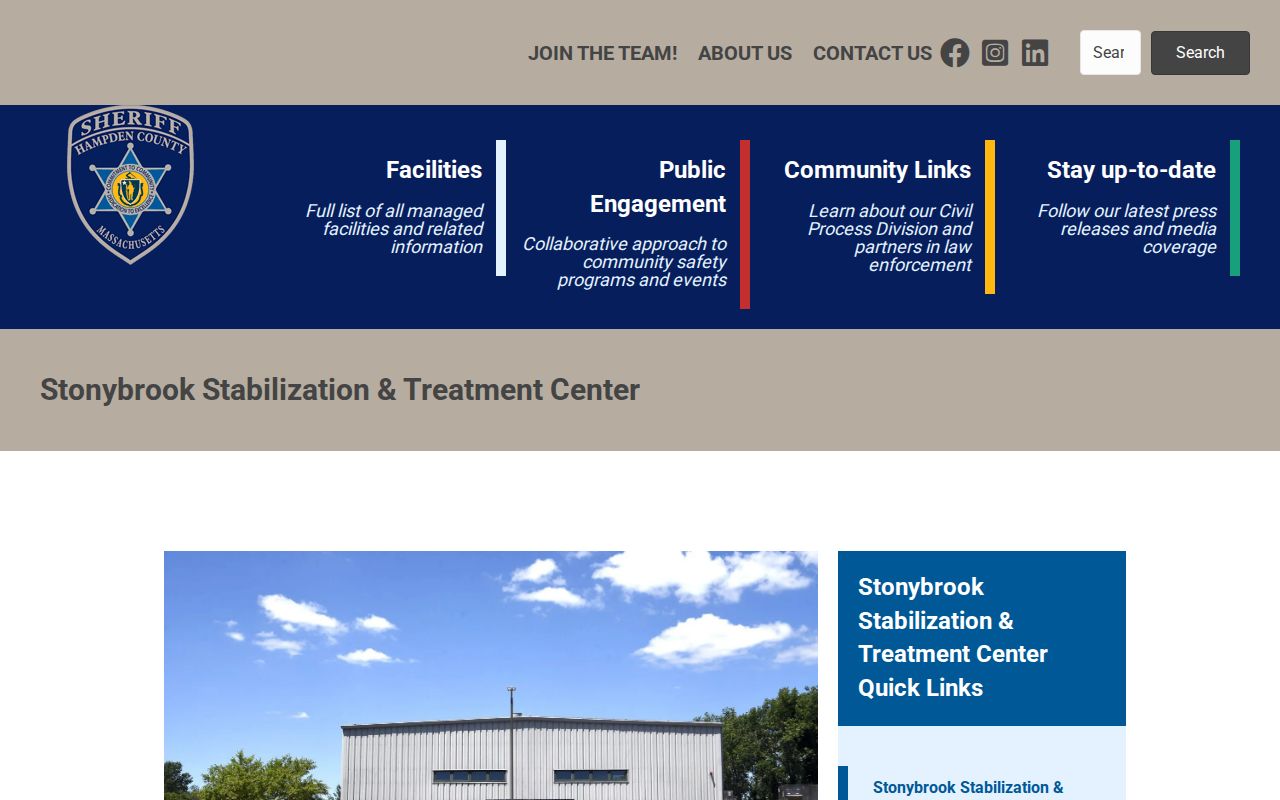
The official page confirms the Section 35 treatment function that must guide any discharge description or records request.
Stonybrook and Separate Custody
A Stonybrook endpoint and a criminal-custody event can occur in sequence. If the final civil event says “to jail” or names another criminal-justice agency, the person has left the treatment center but has not returned to the community. Search the receiving sheriff or agency and the distinct criminal docket. Do not use the civil commitment record as proof of what happened under the separate case.
Likewise, a court destination is not a final answer. The court may terminate the civil order, send the person to another placement, address another matter, or produce a later custodial event. Follow the chronological record until the destination is clear. When the person enters ordinary HCSO custody, the Hampden County custody and release search explains the county record, court, MA DOC, federal, and immigration paths.
Massachusetts VINELink becomes relevant only if Massachusetts Department of Correction custody is independently established. It is not a Stonybrook discharge list. BOP and ICE searches likewise answer only federal prison or immigration custody questions. The building is run by a sheriff, but the source must match the legal status, not merely the operator’s name.
Note: Record two events when civil treatment ends and another custody starts; combining them into one “release” loses the receiving authority.
Accurate Stonybrook Discharge Language
Use the source’s exact label. “Community release” or “discharge” can describe the end of the civil placement when the destination supports it. “Transfer to another Section 35 center” describes continued treatment placement. “To court” identifies a judicial destination. “To jail or another criminal-justice agency” indicates a handoff to a different system. A medical rescission or Section 12 outcome should retain that official category without adding a clinical interpretation.
Do not call a Section 35 commitment a sentence. Do not call the person a convicted inmate based solely on Stonybrook placement. Do not treat the statutory maximum as a scheduled release date. Reviews, discharge criteria, court action, clinical process, and another legal order can affect the endpoint. The actual event and date are more reliable than a projected assumption.
A public record may be sparse. That is expected when civil and medical confidentiality applies. Sparse information is not evidence that the person remains at Stonybrook or that a community discharge occurred. The defensible result is the releasable fact supplied by the center, HCSO, or court, plus a clearly identified transfer record when another authority took over.