
Hampden VINELink Coverage
VINE is a custody-status and notification system that receives data from participating agencies. In Massachusetts, the central local fact is narrow coverage. The Commonwealth's official prison locator instructions say only the Massachusetts Department of Correction participates. The Massachusetts VINELink portal therefore serves state DOC records, not all correctional sites in the Commonwealth.
Hampden County Correctional Center, Western Massachusetts Regional Women's Correctional Center, Western Massachusetts Recovery and Wellness Center, and Stonybrook are under the Hampden County Sheriff's Office. They do not feed Massachusetts VINE. A person transferred from HCSO into MA DOC may later appear because the custodian changed. For a person held only by HCSO, use the sheriff's release-event record and the controlling court.
This boundary prevents a common error. VINELink is not Hampden County's missing jail roster or recent-release list. It also does not search BOP, USMS, ICE, or another sheriff's data. Determine the last custodian before entering a name.
Search Hampden VINELink Records
Search one person at a time. A commitment number is more precise than a name, while a full first and last name can work when the number is unknown. Do not select a result merely because the name looks right. Compare the reporting agency, record identifier, and all permitted details shown by the live system.
- Open the Massachusetts state portal and choose “Search for Someone.”
- Select the incarcerated-person or offender search displayed by the current interface.
- Enter the MA DOC commitment number when known. Otherwise enter the complete first and last name.
- Complete the CAPTCHA or account step if the portal requests it.
- Compare the agency, ID, and other displayed identifiers across possible matches.
- Open the correct record and note the exact custody status, status date, reporting agency, ID, and access date.
If there is no match, check spelling and confirm that MA DOC was actually the custodian. An absent result can reflect a data delay, an aged-out released record, a name mismatch, or a person who was never in the participating system. The Hampden County released-inmate lookup covers the HCSO, court, federal, and immigration paths that VINELink cannot replace.
The captured VINELink portal screen shows the correct Massachusetts selection and search entry point.
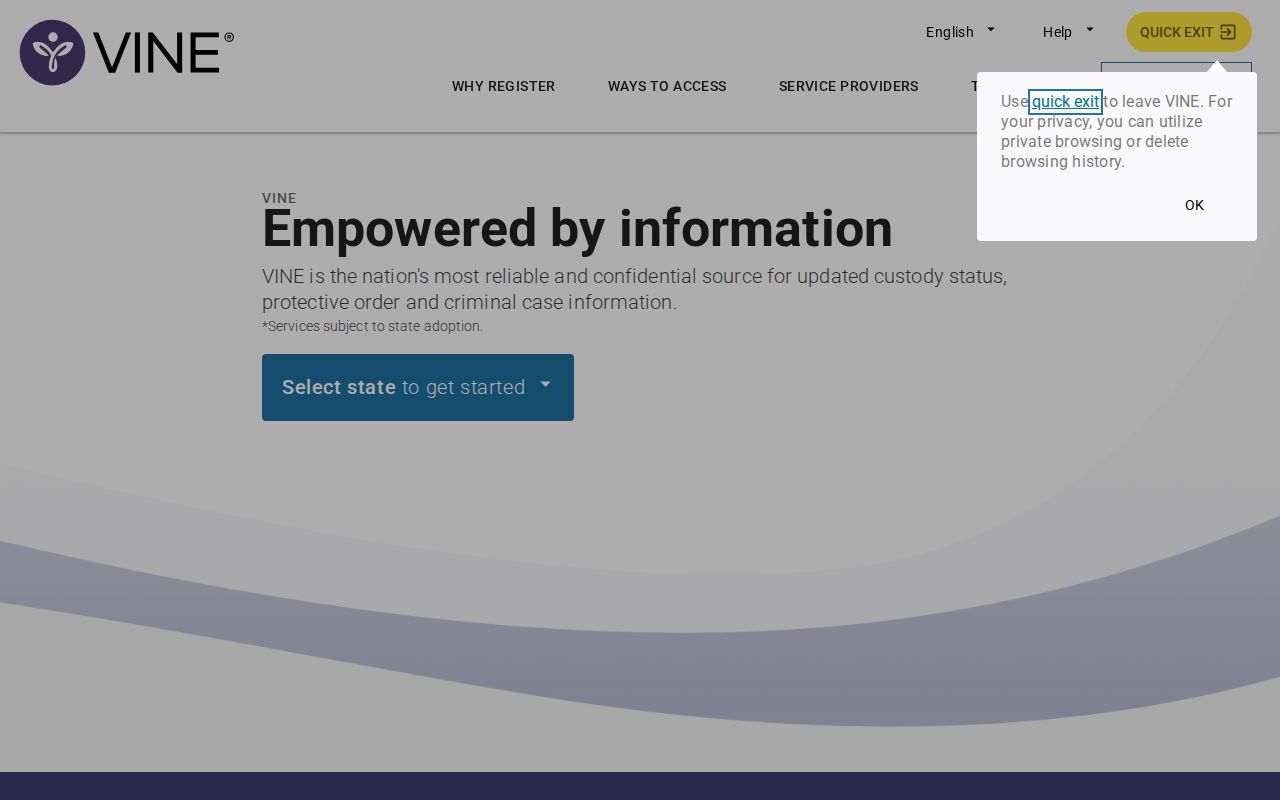
The screen is a search interface, not proof of any person's current custody or release.
Hampden VINELink Release Fields
VINE's current interface and help material say participating records can include people in custody or recently released. The available fields vary. Transcribe the result exactly and resist turning a blank or unfamiliar field into a conclusion. Massachusetts does not publish a permanent retention period for released results.
| Field | How to read it |
|---|---|
| Custody status | The current status language received from MA DOC, such as an in-custody or released state when returned |
| Status date | The date attached to that status, not necessarily a full archival timeline |
| Reporting agency | Confirms whether the result is an MA DOC record |
| Record or commitment ID | The strongest field for separating people with similar names |
| Custody detail | Any facility or status detail that the live record currently exposes |
| Notification methods | The alert channels offered for the matched participating record |
A result marked released or out of custody supports an exit from MA DOC. It does not rule out parole, probation, another sheriff, federal custody, or immigration custody. A status date also should not be relabeled as the exact door-exit time unless the source says that is what it means.
Massachusetts' public locator does not promise that every record displays a projected release date. Do not infer one. When exact movement or release details matter, use the MA DOC records request and ask for the existing event in narrow terms.
Register Hampden VINELink Alerts
Registration begins only after the correct MA DOC record is open. Choose more than one available channel when practical. Keep all contact details, verification codes, and PINs private. The code used to confirm an account is not the same as the PIN used to acknowledge a phone alert.
- Open the matched record and find “Notification Methods.” Select “Add.”
- Choose the offered channel and language. Options can include phone, TTY, text, or email.
- Enter the contact information requested by the current interface.
- For a telephone alert, create and confirm a four-digit PIN, then submit the registration.
- If an account is required, verify control of the email address or mobile number with the code VINE sends.
- When an automated call reports a change, listen and enter the four-digit PIN followed by the pound sign to acknowledge it.
Acknowledgment stops repeat calls for that alert. Email does not use the telephone PIN-and-pound process. Text may require a PIN under the current flow. The general VINELink number listed by Massachusetts is (866) 277-7477. MA DOC Policy 407 separately identifies its VINE automated line as (877) 421-8463, so keep each number tied to its source.
Confirm Hampden Release Alerts
VINE data comes from the participating agency and can lag because of transmission, processing, or an outage. Treat an alert as a prompt to verify. For urgent accuracy, contact the reporting facility or agency. When the source is MA DOC, compare the status with the court or parole record and request the DOC movement or release event if the result is unclear.
For an HCSO detainee, bypass VINE from the start. The HCSO Records Access Officer accepts written requests by email or mail for existing release-event fields. The sheriff's records page states that phone or voicemail requests are not accepted. A court disposition can show why release was authorized, but it does not prove the precise time the person left the facility or whether another hold took control.
Federal and immigration records use different tools. The BOP Inmate Locator can return a released or “Not in BOP Custody” result for federal prisoners in its covered period. ICE ODLS is a current and limited recent-custody tool. Neither system sends records into Massachusetts VINE. A transfer from HCSO to another agency is release from county custody, not necessarily release to the community.
Note: Save the exact status wording, agency, record ID, and access date before following up with the official custodian.
Massachusetts Restricted Release Notices
Massachusetts also has a separate DCJIS Victim Services process for some victims, witnesses, specified family members or guardians, and people who can document a safety concern. The official registration route can provide confidential notice of moves to lower security, escape, and temporary, provisional, or final release when eligibility is met.
This registry is not the anonymous public VINELink search. It requires documentation and should not be presented as open enrollment for everyone. The information supplied through it can also differ from the public fields shown in a VINE record. A person seeking this protected form of notice should follow the DCJIS instructions and submit only the requested proof.
The distinction matters in Hampden County because neither service turns into an HCSO release feed. Public VINE remains MA DOC only, while the restricted registry has its own eligibility and confidentiality rules. County jail confirmation still comes from HCSO and the court.
Hampden Registry Search Limits
The Massachusetts Sex Offender Registry is another narrow post-release channel. It covers only people within registry law and public-classification rules. The public cannot access Level 1 registrants. The online system includes Level 3 and qualifying Level 2 people finally classified after the statutory cutoff described by the Commonwealth.
Registry information can include permitted identity, photograph, physical description, registration status, offense, and address categories. It does not ordinarily establish a jail release date or release type. Absence does not prove that no incarceration, release, or registration duty exists. Use it only when the known facts make the registry relevant and keep its status separate from the MA DOC VINE result.
For a current custody or release question, the correct agency record remains the stronger source. A released MA DOC result, a registry entry, and a Hampden court docket may each describe a different stage. Preserve those differences instead of merging them into one status.
Hampden Custody Handoffs
A person can leave an HCSO building without returning to the community. The sheriff's release event may name MA DOC, another county, a warrant authority, federal custody, or immigration as the destination. That first record proves an exit from Hampden County custody. It does not prove the end of custody. Search the receiving system and describe the two events separately.
When the destination is MA DOC, VINELink becomes relevant after the state agency takes control and sends its data to VINE. Search with the commitment number if one has been assigned. Compare the reporting agency and status date. A delay between HCSO's transfer record and a VINE result can reflect booking or data transmission, so keep the HCSO event and the MA DOC event on their own timelines.
For federal custody, use the BOP locator when the person is in its covered system and the federal docket for legal context. USMS has no public historical person locator comparable to BOP. For ICE, use the Online Detainee Locator with an exact A-number and country of birth or the required identity fields. A missing result can have several causes and is not a release certificate.
This two-step method also prevents a false alert expectation. A VINELink registration tied to MA DOC cannot notify a user about an earlier HCSO release, a later BOP change, or an ICE decision. Register only on the correctly matched participating record and continue to verify major changes with the agency named in the status.
Keep each confirmation with its access date. Custody data can change, while the underlying release or transfer record preserves the event that occurred.