
Recovery Center Custody Status
The Western Massachusetts Recovery and Wellness Center is a co-ed regional minimum-security and community-based residential treatment placement. In the facility map, it is the work-release and step-down type of HCSO site. The terms “minimum security” and “community based” describe the setting and program model. They do not, by themselves, mean that the resident has finished the custodial phase or is free of a governing order.
A person can arrive from the Main Institution, the regional women’s center, another HCSO status, or a regional committing source. Admission to Mill Street may be an internal or regional custody movement. During the placement, the person may take part in structured treatment and transition programming while HCSO still records a legal status. The final outcome can be community release, release to parole or probation, transfer, return to a more secure HCSO placement, return to the committing agency, or another action under the controlling order.
| Mill Street event | What it proves | What remains to verify |
|---|---|---|
| Admission | The person entered the WMRWC placement | Whether prior custody ended or merely changed location |
| Program completion | A program milestone was recorded | Whether legal custody or supervision also ended |
| Movement | The placement changed | The next HCSO or outside destination |
| Final release event | The recorded Mill Street exit and type | Whether the destination was community or another authority |
Recovery Center Release Destinations
The destination field is central at WMRWC. A community outcome can follow completion of the custodial phase, sentence expiration, a court order, parole, probation, or another lawful release. A resident can also move back to another HCSO facility. Regional cases may require return to a committing sheriff or agency. A warrant, detainer, new court action, or other authority can produce a transfer instead of community release.
HCSO’s 2023 Release Report uses “Release to Community” for people who physically leave custody to the community, including some people released on parole or probation. It separates those events from transfers to other agencies and facilities. Apply that same distinction to Mill Street. An exit from the center is not enough. The final event should state whether the person went to the community, another HCSO placement, a court, MA DOC, another sheriff, or another authority.
For a sibling HCSO move, the Main Institution release record explanation shows why the full movement chain must reach an executed community exit before it is described as release.
Confirm Recovery Center Release
There is no official WMRWC public roster, recent-release feed, or person-level lookup. The HCSO website identifies the facility and program, but it does not return the current or released status of a named resident. Massachusetts VINELink is MA DOC-only. It does not cover WMRWC solely because HCSO operates the center in Hampden County.
- Collect the resident’s exact name, lawful birth information, booking number, approximate Mill Street dates, prior facility, and controlling court or agency.
- Request both the Mill Street admission or movement record and the final HCSO event, not just a generic status answer.
- Ask for actual event dates, facility names, event type, destination code, legal reference, and receiving authority when releasable.
- Read the controlling court docket or supervision source to determine which legal status ended and which one continued.
- If the event names a transfer, obtain confirmation from the receiving custodian before calling the outcome a community release.
A narrow request is usually stronger than asking for every inmate record. It can state: the WMRWC admission or movement event and final release or transfer event for the identified person, including event date and time, release type or destination, booking number, and related docket, with exempt fields redacted. This asks for existing system fields rather than a new analysis.
Note: A missing web result has no release meaning because HCSO provides no public WMRWC named-person database in the first place.
Recovery Center Release Records
The HCSO Records Access Officer is the formal county record channel. Requests must be sent in writing by email or mail. HCSO’s official records page says phone and voicemail requests are not accepted. The RAO phone number can be used for procedural questions or to ask about the status of a request already submitted.
HCSO Records Access Officer
Theresa S. Finnegan, Assistant Superintendent and General Counsel
Hampden County Sheriff’s Office
627 Randall Road
Ludlow, MA 01056
Email: theresa.finnegan@SDH.state.ma.us
Fax: (413) 589-1851
Questions or status: (413) 858-0164, Monday through Friday, 8 a.m. to 3 p.m.
Use the official HCSO records page for the current submission channels. Identify “Western Massachusetts Recovery and Wellness Center, 155 Mill Street” so the request is not confused with the noncustodial Community Safety Center or day-reporting function at the same address. Also identify the prior HCSO placement or regional committing source if known.
Offer electronic production, allow lawful redaction, and request an itemized fee estimate before chargeable work. HCSO posts no special WMRWC release-record or booking-photo fee. CORI, privacy, medical, treatment, juvenile, investigatory, security, and sealed-record rules may limit what can be released. Ask for the releasable event fields even if other case material is restricted.
Recovery Center Contact Details
The HCSO led by Sheriff Nick Cocchi supplies the Mill Street facility contact information. The main number can route an operational question, but it should not be treated as a substitute for a written public-record request. Be specific about whether the call concerns a custodial resident, the residential treatment placement, or a noncustodial community function associated with the site.
Western Massachusetts Recovery and Wellness Center
Regional minimum-security and residential treatment placement
155 Mill Street
Springfield, MA 01108
Main phone: (413) 886-0110
Administrative fax: (413) 886-0123
Intake fax: (413) 886-0122
The official WMRWC page is shown in the captured image below.
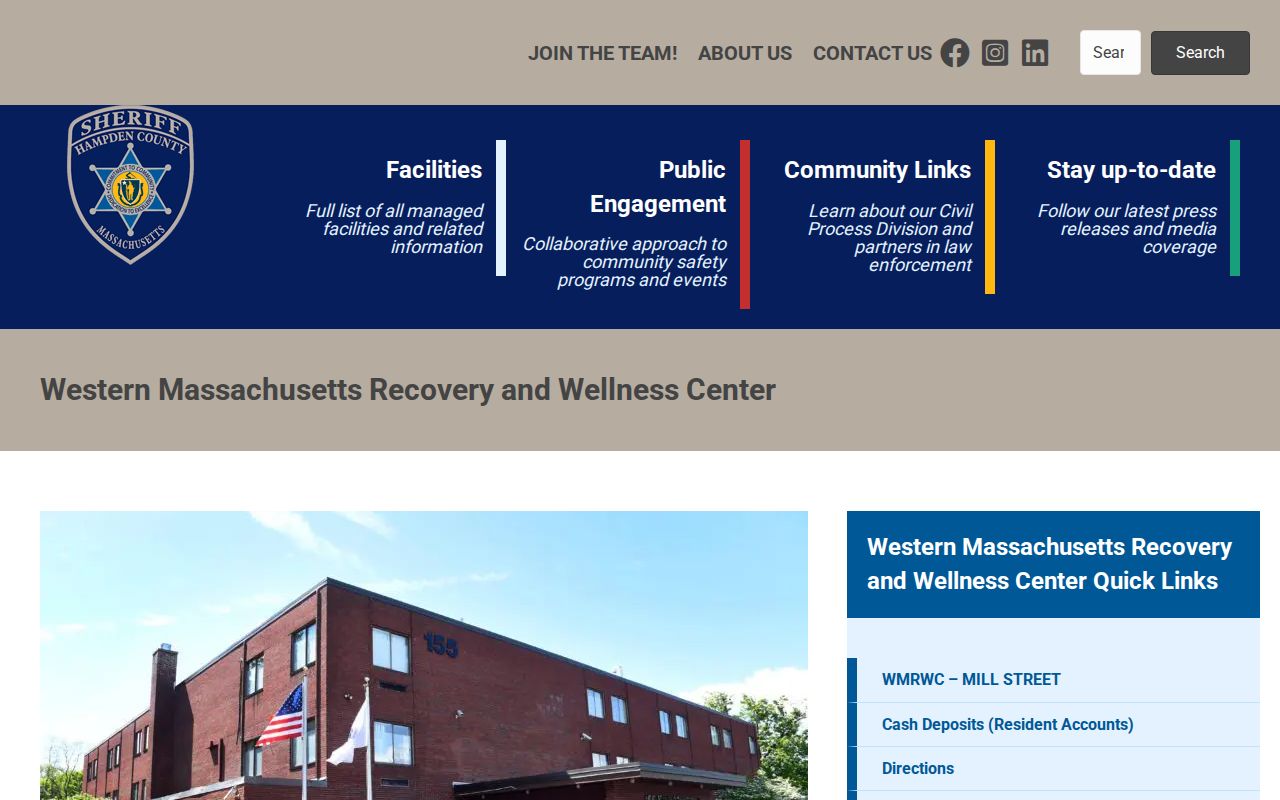
The page confirms the program’s regional, minimum-security, community-based role, which is why a named final event is still needed to prove discharge.
Recovery Center Legal Context
The controlling legal source may be a court sentence, pretrial order, parole action, probation term, or regional committing arrangement. Match the WMRWC event to that source. A court docket can show the order and later changes. Parole material can show authorization and conditions. Probation records can show a court-supervised stage. None of those sources alone necessarily gives the exact time the resident left Mill Street.
Use MassCourts public access when the exact docket is known and the case is public. Massachusetts criminal cases often require the exact docket number online. For a regional resident, do not assume that Hampden County supplied the case merely because WMRWC is in Springfield. Contact the originating clerk when the public interface cannot expose the matter or when the correct division is unclear.
- Custody
- The agency’s legal or physical control of the person.
- Step-down
- A move to a less secure or more community-based setting before final release.
- Discharge
- The formal end of a defined custody, sentence, program, or supervision status.
- Detainer
- A notice or request tied to another authority that can affect the next destination.
- Transfer
- A handoff from one facility or agency to another, not release to the community.
Recovery Center Event Fields
WMRWC verification is most useful when the record shows a sequence rather than one isolated date. Ask for the prior facility or source, the Mill Street admission date, later movement events, the final exit time, the coded reason, and the destination. The booking number or facility identifier helps prevent a same-name match. The related docket or mittimus connects the agency event to its legal basis.
Keep each date’s label. An admission date marks entry into Mill Street. A program-completion date may mark treatment progress. A court disposition records judicial action. A parole vote may authorize a future step. A final event time records the HCSO movement or exit. Merging these dates can create a false release timeline.
HCSO’s Jail Management System feeds aggregate state Cross-Tracking data, but the dashboard does not identify people. It can show agency-level release counts and types. It cannot confirm that one named WMRWC resident was released. The person-level event must come from HCSO and the relevant legal source.
Note: Preserve HCSO’s exact destination code because “release” in aggregate reporting can include a transfer or end of one legal status.
After Recovery Center Exit
A genuine community release can still lead to parole, probation, electronic monitoring, treatment terms, or another court obligation. Those are post-custody legal stages, not proof that WMRWC still holds the person. Confirm them only through the office or docket that owns the status. Do not infer a person’s present location from a release record.
HCSO’s All-Inclusive Support Services is a noncustodial community reentry contact. It is not a jail, WMRWC annex, parole locator, or proof that a named person was released. Likewise, the Community Safety Center and day-reporting functions connected with Mill Street can be out-of-custody operations. Presence in a community program must not be represented as detention without a current legal record.
The distinction is simple but vital: program location, custody status, and supervision status are three separate facts. The WMRWC admission and final event answer the placement question. The court or Parole Board answers the legal authority. The destination and receiving source answer whether the person reached the community or entered another form of custody. A transfer to Massachusetts Department of Correction starts a state record trail separate from the county placement.