
Main Institution Release Paths
The Hampden County Correctional Center Main Institution is the county jail and house of correction. Its medium-security units serve two broad groups. Pretrial detainees are held while cases are pending. Sentenced residents are serving house-of-correction terms. Temporary regional lockup, safekeep, state, and federal arrangements can add other legal statuses. The building name alone therefore does not show why a person was there or what happened next.
A community release can follow bail, personal recognizance, another court release, time served, sentence expiration, parole, or probation. Some people move to a lower-security HCSO program before their final exit. Others leave the Main Institution because another sheriff, MA DOC, a court, police, a warrant authority, BOP, USMS, or immigration authority takes custody. That second group has left Hampden County Correctional Center but has not necessarily returned to the community.
| Recorded event | What it means | Best next check |
|---|---|---|
| Release to community | Physical exit under bail, court action, sentence end, parole, or probation | HCSO event plus the court docket |
| Lower-security movement | Placement changed while HCSO custody or structure may continue | HCSO movement and final event records |
| Agency transfer | County custody ended and another authority may have begun custody | Receiving-agency confirmation |
Confirm Main Institution Release
HCSO does not publish a public named-person roster or a recent-release feed. Absence from the Sheriff’s website is not proof of release. The strongest county evidence is an existing release-event record that identifies the person, releasing facility, actual date and time, event type, and destination. Read that event with the court docket that supplied the legal basis. A docket may show bail, dismissal, a time-served sentence, or another order, but it does not establish the exact moment staff completed the exit.
- Collect the exact name, lawful date-of-birth information, name variants, booking number, court docket, and approximate custody dates.
- Search the public MassCourts case system using the exact docket number when available, then read the chronological events and disposition.
- Send a narrow written request to the HCSO Records Access Officer for the Main Institution booking event and final release or transfer event.
- If the destination is another agency, follow that agency. Use Massachusetts VINELink only when MA DOC custody is established.
- Preserve the exact status wording. Do not turn “not found,” “release at court,” or “transfer” into a claim of community release.
The broader Hampden County released-inmate search and records path explains how court, county, state, federal, and immigration systems fit together when custody changed more than once.
Main Institution Bail Release Review
Bail is mittimus-specific. A mittimus is the court commitment or detention authority tied to one matter. The HCSO bail procedure says an Intake Supervisor checks for other legal holds before release. Payment on one case does not cancel a warrant, a second mittimus, a federal or immigration hold, or another authority’s custody. The signed bail mittimus authorizes release only from the matter it covers.
An ELMO condition adds another local step. ELMO refers to electronic monitoring. When the mittimus requires it, HCSO states that the person is held and transported to the next session of the issuing court, subject to other holds. A bail receipt, payment time, or docket entry is thus not the same as the physical Main Institution exit. Ask for the actual release-event time and destination after the hold review is complete.
The official HCSO bail page is shown in the captured release-workflow image below.
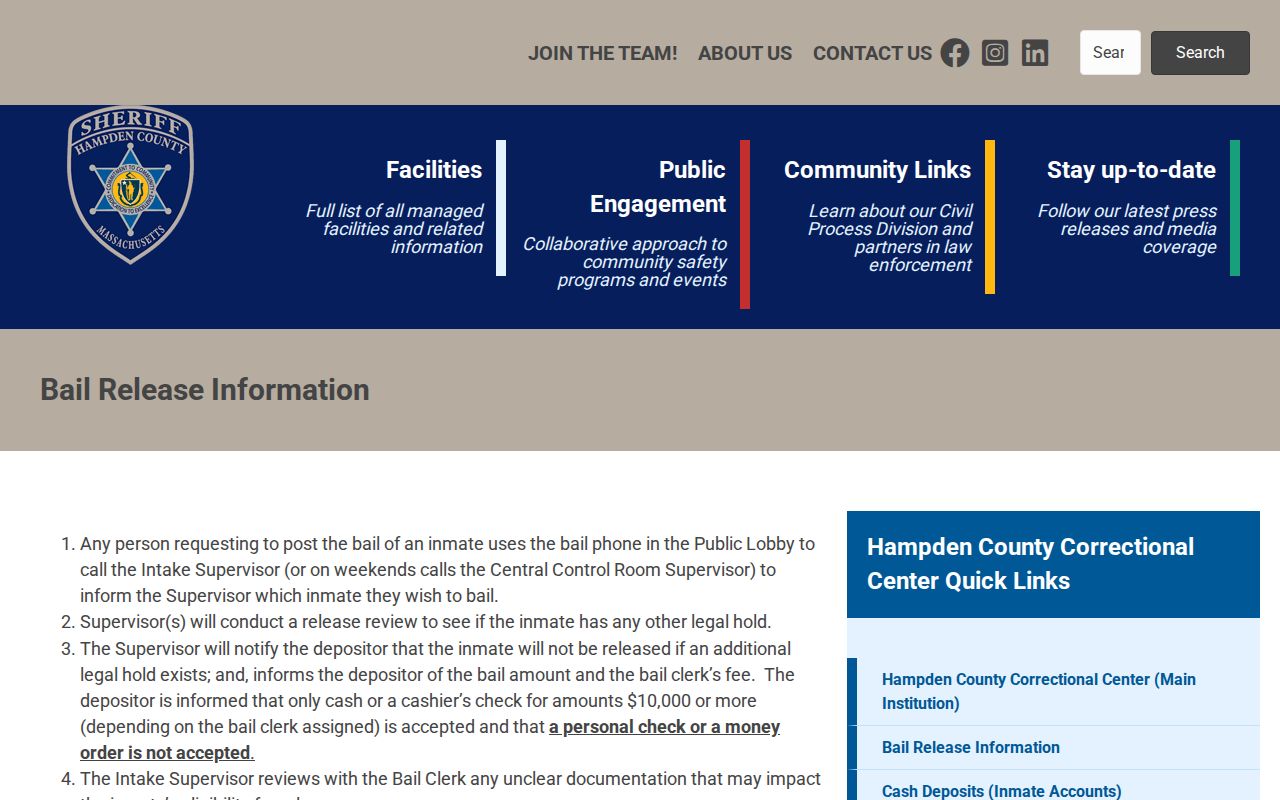
The page documents the local hold check that makes the final HCSO event more reliable than a bail payment alone.
Note: The Main Institution publishes no universal release hour, so do not apply another facility’s bail schedule to Ludlow releases.
Main Institution Release Records
The HCSO Records Access Officer is the official route for an existing county booking, movement, or release record. Ask for a record, not a new narrative. A useful request names the Hampden County Correctional Center, identifies the person and date range, and asks for the admission event and final event, including actual date and time, release type or destination code, booking number, and legal case reference. Request the booking photograph separately if it is needed. HCSO has no public photo gallery.
HCSO Records Access Officer
Theresa S. Finnegan, Assistant Superintendent and General Counsel
Hampden County Sheriff’s Office
627 Randall Road
Ludlow, MA 01056
Email: theresa.finnegan@SDH.state.ma.us
Fax: (413) 589-1851
Questions or request status: (413) 858-0164, Monday through Friday, 8 a.m. to 3 p.m.
The official records page says telephone and voicemail requests are not accepted. Use email or mail for the request. The listed phone is for questions about the process or the status of a request already filed. Offer to receive electronic records and allow lawful redaction. Protected CORI, medical, juvenile, investigatory, security, sealed, and private material may be withheld even when the underlying event exists.
Hampden Correctional Center Contact
The Main Institution sits on the HCSO campus in Ludlow. The office led by Sheriff Nick Cocchi and Mass.gov publish different official phone numbers, so each should retain its source label. The Sheriff’s facility page lists (413) 858-0000. The Mass.gov location page lists (413) 547-8000, fax (413) 589-1851, and administrative hours Monday through Friday from 9 a.m. to 5 p.m. Those are administrative details, not a promise that a named person’s release record will be given by phone.
Main Institution
Hampden County Correctional Center
627 Randall Road
Ludlow, MA 01056
HCSO facility number: (413) 858-0000
Mass.gov main number: (413) 547-8000
Administrative hours: Monday through Friday, 9 a.m. to 5 p.m.
The official Main Institution page supplies the facility identity and operational navigation shown in the capture below.
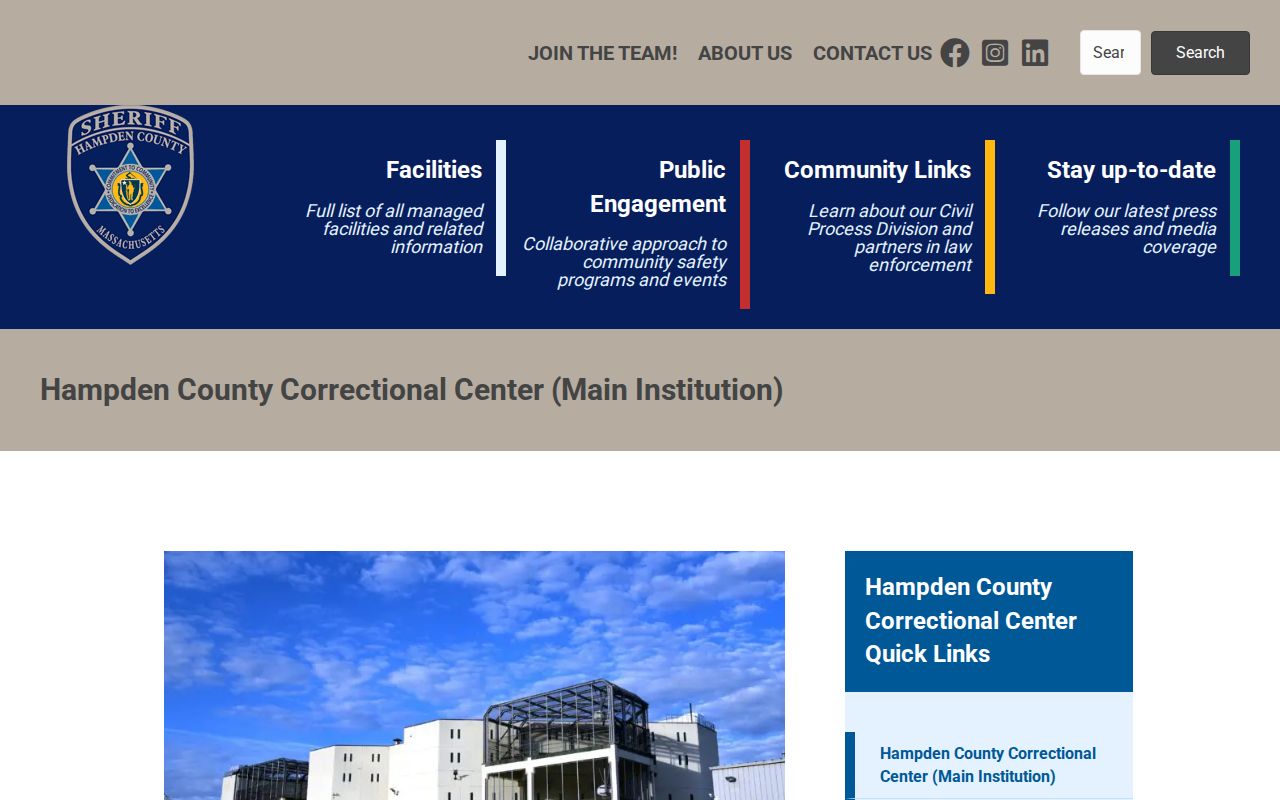
The Main Institution page confirms the facility context and operational links, while the centralized RAO remains the formal release-record channel.
Main Institution Record Fields
A complete event should answer who left, which custody ended, when it ended, how it ended, and where the person went next. HCSO’s internal Jail Management System contains more detail than the public website. Massachusetts county record rules require a facility case record with legal, court, sentence, identification, program, community-program, and parole material as applicable. Not every field is public, but requesting named existing fields makes the response easier to match and review.
- Booking number
- The HCSO identifier that helps separate people with similar names.
- Release date and time
- The executed physical exit or transfer event, not a projected date or court-entry time.
- Release type
- The agency code for bail, court release, time served, sentence end, supervision, or another event.
- Destination
- Community, another HCSO placement, MA DOC, another sheriff, court, warrant authority, or other receiving entity.
- Mittimus or docket
- The legal matter connected to the custody and release authorization.
HCSO’s local terms matter. “Release to Community” excludes transfers to another agency. “Release at court” may group records where a more specific time-served detail did not migrate reliably from the court. Compare the Sheriff’s event with the docket instead of forcing one field to answer every question. If Massachusetts Department of Correction is the destination, begin a new state-custody verification rather than extending the county event.
Note: A transfer ends one agency’s custody but may begin another, so destination is as important as the word “release.”
After Main Institution Release
Community release can still carry parole, probation, electronic monitoring, or another court condition. Parole follows a custodial sentence under the Massachusetts Parole Board. Probation is court-based and can follow custody or arise without it. Neither status should be guessed from the fact that someone left Ludlow. Use the release type, court docket, and the proper supervision office to identify the legal stage.
HCSO also publishes limited post-exit logistics. Remaining account funds may be collected at the Main public-lobby account window Monday through Friday from 8 a.m. to noon and 1 p.m. to 3 p.m., subject to change. Separate property rules allow approved release to an outside person with photo identification on Monday, Wednesday, and Friday from 9 a.m. to 3 p.m. Those property-exchange hours are not described as the complete process for every final discharge, so confirm before travel.
The facility page links to PVTA route B12 as a transit lead for the Ludlow campus. Exact stops and times should be checked with PVTA because schedules change. No fixed transportation plan or universal exit time applies to every release. Bail processing, court transport, sentence calculation, and a receiving agency can each produce a different path from the same building.
Account or property pickup also should not be confused with custody status. A relative may be able to collect approved property while the person remains held, and a former resident may need to return for funds after the recorded exit. Confirm the person’s release through the final event first. Then call the correct public-lobby function about the item, required identification, current hours, and who is authorized to receive it. This order keeps an administrative pickup from being treated as proof that a sentence, mittimus, or hold ended.